

Donations to our Kiltwalk team
Thank you so much to everyone who donated to our Kiltwalk team and sent messages of support. The team walked a combined distance of over 280 miles, and have raised over £5000!! We’d like to give a massive shout out to our team members:
🚶Wee Wanderers: Isabella, Natalie, Tiegan, Ashley and Keeley
🚶♀️Mighty Striders: Jill, Suzann, Sam, Kirsty, Beth, Shannon, Esther, Keri, Carley, Colleen, Margaret, Laura, Denise and Shaunie.
There’s still time to donate to the team, if you’d like to, via the link in bio.
Report from Chair of the Board

On behalf of Stirling Carers Centre, it is my great pleasure to present the Annual Report for 2021/22.
Last year Covid, and its consequences, both wellbeing and economic, were at the front of my mind when I wrote this report. This year the challenges are different, not least the many factors affecting the cost of living, however what has remained the same is the dedication and unfailing commitment of our staff and the pride that we have in them.
Over the course of the last year the staff have, once again, worked tirelessly bringing valuable services, advice, assistance, and companionship to the unpaid Carer community that it is our privilege to support. Yet again the most enormous thank you to all our staff and a continued pledge to support them as well as they are supporting unpaid Carers across Stirling and the region. I’d also like to thank all our statutory and independent funders; We cannot express our gratitude enough and could not deliver the degree and excellence of service for Carers that we wish to without your kind and gracious support.
Next year will be challenging for many.
I have complete conviction that the staff, volunteers, Carer representatives, partners, and Board members of the Centre will continue to provide, and strive to improve, all our services, in order to help alleviate those challenges.
Thank you once more, to all of them, and to you.
David Khan
Chair of the Board
Overview of the 2022/23

New Carers registered
Carers
re-registered
Carers directly
supported
Granted in short
breaks grants
Adult Carer Support
Plans completed or reviewed
Adult, Young Adult & Young Carer short breaks activities attendances
Young Carer Statements completed or reviewed
Key Developments

This year, the organisation has been focussed on relaunching face-to-face service delivery, rebuilding partnerships and raising awareness of our services in the wake of the pandemic.
Statement of Financial Activities

Reserves Policy
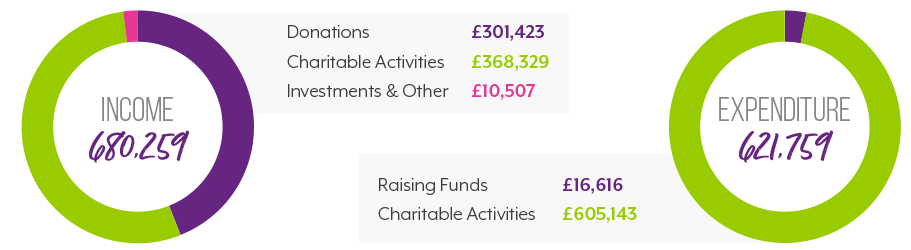
For the year ended 31 March 2022, the Statement of Financial Activities shows an overall deficit of £66,200 (2021 – surplus £58,501).
our statutory partners

The substantial funding we receive from our statutory partners, Stirling Council and NHS Forth Valley, allows us to provide many of our core services to Unpaid Carers, and for this we are most fortunate. However, our additional services are funded by a range of trusts and individual donors, without whose support our service would be greatly restricted. We would like to extend our thanks for their on-going support.











Trusts & Foundations
The Alchemy Foundation
Appletree Trust
Arnold Clark Community Fund
Bank of Scotland Reach
Children in Need
Co-operative Community Fund
Cash for Kids
Castansa Trust
Cruden Foundation
The Cruach Trust
The David Family Foundation
Frognal Trust
Global’s Make Some Noise
The Henry Smith Charity
The Hugh Fraser Foundation
JTH Charitable Trust
Life Changes Trust
Lottery Community Fund
The MacRobert Trust
National Lottery Community Fund
The Roberston Trust
Stirlingshire Voluntary Enterprise – Communities Health & Wellbeing Fund
Tesco Bags of Help
Woodroffe Benton Foundation
Local Giving
Allan Church, Bannockburn
Inner Wheel Club of Stirling
Rotary Club of Stirling
St Mark’s Church, Raploch
Yardi Systems Ltd, Stirling
In-kind Donations
B & M Stores, Stirling
Endrick Yoga, Killearn
Morrisons, Stirling
Stirling Observer
Waitrose & Partners, Stirling
Yoga Tree, Stirling
Verbena Therapies

Report from Chair of the Board
On behalf of Stirling Carers Centre, it is my great pleasure to present the Annual Report for 2022/23.
Even more pleasing is to report that the Centre continues to go from strength to strength.
Despite the turbulence of the last few years, with Covid, cost of living, and other pressures, Stirling Carers Centre has continued to provide and grow essential services alongside raising the funding required to do that, and winning awards and gaining accreditation that recognises its value and excellence.
As always, the Board wishes to thank all the parties that have made this a reality. Our staff who continue to be the heart of the Centre and show the most inspiring dedication to bringing valuable services, advice, assistance, and companionship to the Carer community that it is our privilege to support. I’d also like to thank all our statutory and independent funders once more; your support is, of course, essential, greatly appreciated, and never taken for granted.
Alongside the provision of service, the less visible work of supporting each other, ensuring the finances of the Centre remain strong and robust, our branding and ability to reach those who may need us, and many other important elements have also been operating at the highest standard. I’m really pleased that the awards and accreditations, like the Charity of the Year, recognise that alongside provision of excellent service to our community, the Centre is also extremely well run.
I look forward to seeing what next year shall bring.
David Khan
Chair of the Board
Overview of the 2022/23

New Carers registered
Carers
re-registered
Carers directly
supported
Granted in short
breaks grants
Adult Carer Support
Plans completed or reviewed
Adult, Young Adult & Young Carer short breaks activities attendances
Young Carer Statements completed or reviewed
Key Developments
It’s been an eventful year for the Centre, with the highlights being the awards received for the high quality service that we provide to Carers.
Statement of Financial Activities
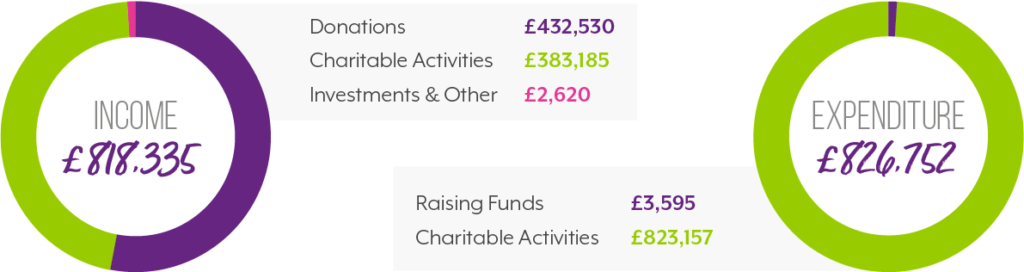
For the year ended 31 March 2023, the Statement of Financial Activities shows an overall deficit of £8,417 (2022 – deficit £66,200).
The reserves policy adopted by the Board is based on the major risks facing the organisation. An estimate has been made of the policy monetary impact and risk weighting based on the likelihood of an unforeseen event occurring. This allows a monetary value to be assigned to the reserves required. The level of reserves is monitored by the Directors on a quarterly basis.
As at 31 March 2023 the total unrestricted reserves stood at £399,865 (2022 – £374,719) out of which £29,998 (2022 – £29,998) has been designated to be used in the coming year to cover the costs of the Carers Health Improvement Initiatives; this leaves free reserves of £369,867 (2022 – £344,721). The Directors aim to maintain free reserves at a level of three to six months annual expenditure, which is considered sufficient to cover staff and operating costs on a short-term basis to allow for restructuring in the event of a significant decrease in funding. The level of free reserves at 31 March 2023 was within the Board of Director’s target.
our statutory partners



Trusts & Foundations
Bank of Scotland Foundation
The Batchworth Trust
Cash for Kids
Children in Need
Christina Mary Hendrie Trust
Co-operative Community Fund
Cruden Foundation
The David Family Foundation
Garfield Weston Foundation
Global’s Make Some Noise
The Hedley Foundation
The Henry Smith Charity
Life Changes Trust
National Lottery Community Fund
The Roberston Trust
Stafford Trust
Tesco Bags of Help
Local Giving
Allan Church, Bannockburn
Inner Wheel Club of Stirling
Rotary Club of Stirling
St Mark’s Church, Raploch
Yardi Systems Ltd, Stirling
In-kind Donations
Endrick Yoga, Killearn
Morrisons, Stirling
Stirling Observer
Tesco, Stirling
Waitrose & Partners, Stirling
Yoga Tree, Stirling
Verbena Therapies
Schools for Young Carers
Our Young Carers Service works in partnership with schools across the Stirling Council area to raise awareness of Young Carers and the issues they face, and to improve the support available.
There is a lot of good work being done to support Young Carers in Stirling’s schools. The attached image shows Braehead Primary receiving their second We Care Award, which shows the hard work and commitment they have put into supporting Young Carers in their school.
To promote and facilitate this level of support across Stirling, Esther, one of our Young Carers Team, has been meeting with the Young Carers Co-ordinators at each of the Stirling schools to discuss their support provision within school.
Alyn Smith MP coming along to talk
Thanks to Alyn Smith MP for coming along to talk to us today. We had a great turnout from Carers, and important topics were discussed, including the future of Town Break’s Stirling & Clackmannanshire services, transitions between child and adult services for young people with additional support needs, the waiting list for CAMHS (Child and Adolescent Mental Health Services) and proposed budget cuts.
Alyn will send us a written response to the topics discussed. If you would like to receive a copy of the response, please let us know.
Kate’s Story
Kate is a Carer for her mum, who is 91, her mother in law, who is 96, and was also a Carer for her dad, who had vascular dementia.
Kate’s mum lives in the same street as Kate and her husband. Her parents moved there not long before her dad became ill, and being close by meant they were able to help out with caring for him. Her dad passed away six years ago, and her mum has since been diagnosed with dementia herself.
Kate is the primary support for her mum, and living so close by means there are constant unannounced visits, phone calls, and incidents that affect her job, her relationships and her health.
Working from home during the pandemic along with the cancellation of her mum’s regular activities has added extra pressure, and left Kate and her husband exhausted and unable to take time for themselves.
It’s almost like you feel it’s a sign of weakness if you admit that you have things in your life that might impact on your ability to work, so I didn’t.
I think a huge part of the stress and guilt is are you doing the best thing for your husband, your children, your grandchildren, your mother?
Career Impact
Before her dad became ill, Kate was working in a strategic role within the health service.
As his condition deteriorated, the level of care needed increased, and Kate reduced her hours at work to help out. As the need increased further she took time off work, and eventually decided to take early retirement.
Within a month of making that decision Kate’s dad passed away. While she recognises that she needed the space at the time, she also now realizes she could probably have paid space and returned to the job. Making the decision to leave that role has had an impact on her career, her earnings and crucially on the potential pensions that she would have received had she stayed. She has since had various jobs, but never at the level she was at before.
When she started in her current role she never mentioned that she was a Carer. However, there came a point where the caring role increased again and so she approached her boss to request flexible working.
It was at this point that she found out that her employer had a procedure in place to support that. When Kate said she hadn’t been aware of that, her boss responded “Well, you never seemed to not be coping!”
Trying to hide the situation had meant she had missed out on the support that was available.
Kate’s advice to other working Carers is to find out your employer’s policies on flexible working and time off for dependants. Also, make your employer aware of your caring role and that there might be times when there are greater demands on you at home.

Relationships Impact
Being a Carer and on call 24/7 has meant that Kate and her husband don’t get any meaningful time to themselves.
Evenings are constantly interrupted by phone calls or unannounced visits, and plans and even holidays have often had to be cancelled to deal with situations that have arisen.
It has affected relationships with siblings who are not involved in caring, and it has affected Kate’s ability to support her daughter and her grandkids.
Her husband and children have been very supportive throughout, and this has made a huge difference to her ability to cope. She’s also benefited from support from her local community who look out for her mum, and from having friends that she can talk to.
What could change to better support Carers?
“I think it’s acknowledging it now, especially the Sandwich Generation where people are not only trying to provide support for children and grandchildren, or they’re still bringing up children, and then they’ve got the additional responsibility of elderly parents, or parents with additional needs. It has to be recognised in the same way, I think, as maternity and the early years is.
It’s a huge undertaking, and it costs you. It costs you in pensions, in your ability to work, in your ability to keep healthy, in your ability to engage in clubs, and to maintain friendships. So I think that has to be acknowledged.
And I think that women are probably disproportionately disadvantaged. It has had an impact on my earnings, and it will have an impact on my pension, so from that point of view I think it has to be viewed seriously.”
We would like to thank Kate for taking the time to share her story with us. If you have been affected by any of the issues raised in this story, please contact the Centre for support.
Anne’s Story
Anne is a Carer for her son, who has a brain tumour. She has been a Carer for three and a half years. This is her story in her words.
“In October 2017 my adult son, Michael, was diagnosed as suffering from exhaustion.
The following month he suffered a seizure, but was told he had just fainted and was fine. In February 2018, following an MRI, he was diagnosed as have a space invading brain tumour.
Initially he was advised that a consultant would go in and remove it because it was situated between his skull and brain, but then the neurological consultant advised this diagnosis was wrong – it was actually a grade 3-4 tumour, and a de-bulk would be performed within 2 weeks.
Shock. Horror. Inadequacy. Numb. Sad.
I was in shock and felt guilty that as a mum I had not prevented this from happening.
When you have lost control of everything it is difficult to come to terms with, so regaining some control of your life is paramount.
The de-bulking operation was successful to the extent that around 50% of the tumour was removed, but this left Michael with limited speech, and unable to write, read or tell the time. These functions later returned following therapy.
At the same time the flat he rented was to be sold, so we were looking for accommodation. Four days after his operation he had to move house, so I was left completing all the paperwork for the move, and also for the DWP. Because of everything that was happening, I missed time-scales and could not have it backdated.
Initially caring was relatively straightforward. I was getting up during the night to administer medication, preparing meals, running 3 households. It was time consuming, but it was manageable.
People initially were crowding us. Many were friends who wanted to be there to help or to be able to tell others how he was. Some, though, were very macabre.
We both found that everyone knows someone who has had a brain tumour, and the medical information each of these people knew was astounding. Brain tumour ‘cures’ included everything from using cannabis, to eating an apricot while singing Mamma Mia, doing a handstand and balancing a penguin on your right foot! Maybe it’s your left foot, so don’t quote me.

When you have lost control of everything it is difficult to come to terms with, so regaining some control of your life is paramount. It was so difficult, emotional and heart-breaking watching and being involved with the recovery – I could not fix it, but had to watch Michael struggle to try to express himself and communicate. The speech therapist advised he was to try to find his own words and we were not to help. Also, speech was delayed, so when I thought he was finished a sentence he hadn’t. This understandably led to a great deal of anger and frustration.
Hearing the sobs of frustration and the anger at not being able to do something that he would consider simple was heart wrenching. Trying to stay strong and not get upset while your child is hurting so much is so difficult.
In the background, having to arrange his will, power of attorney, banking, settling into new accommodation, laundry, shopping, sale of his flat, hospital appointments but most importantly time to sit with him and spend quality time was so difficult. This was on top of having to run my own house.
In March 2018 I had to stop working, and by May I had to re-home my dog as I did not have time to take care of him. He went to a very loving home where he is very happy. I have not kept in contact, as I do not think it would be beneficial to any of us.
People kept telling me I had to look after myself, but I was in shock and felt guilty that as a mum I had not prevented this from happening. I was cooking him nutritious healthy meals, but ignoring my needs so much that my weight increased to a dangerous level, and my energy levels plummeted to such a degree that after a year I needed respite. I was lucky enough to be able to take 3 weeks out and fully restore myself.
The brain does not rest though, even in sleep.
For Michael there is no switching off. So many bad dreams and nightmares. Chemo and radiotherapy on the scalp make even lying on a pillow painful, resulting in tears. The constant pain is also resulting in lack of sleep, which means irritability and being irrational. As a mother, it is so difficult not to be able to make it all go away and fix things.
The last year has proved difficult because we haven’t ticked anything off on the bucket list, yet time is still marching on. A whole year out of a 3-5 year prognosis is difficult to deal with. While others are moaning about not being able to go on holiday or to the pub, our priorities are slightly different.
Currently we are both doing well and doing the best we can with what we have. We spend quality time together, mostly in nature when we can. Watching different seasons and appreciating the changes they bring. Hopefully some walks and drives around once the restrictions are lifted, and looking forward to spring and summer, longer days and warmer weather.”
Many thanks to Anne for sharing her story with us. If you have been affected by any of the issues raised in this story, please contact the Centre for support.
Stephen's Story
Stephen is a Carer for his brother, who has a mental health condition. He has been a Carer for 42 years. This is his story in his words.
I have been a Carer for my older brother for 42 years. He has a mental health condition and needs help with all aspects of life.
I love my brother to bits, but it can be overwhelming. Life as a Carer means wearing so many hats – brother, doctor, cleaner, nurse, and more. It often feels more like I’m his dad than his sibling, and I know that’s how he sees me.
The hardest thing I find about being a Carer is the workload. Alongside being a Carer I have my own family and grandkids, as well as being a foster parent, but my brother could not cope without my help so I just get on with it.
Life as a Carer means wearing so many hats – brother, doctor, cleaner, nurse, and more.
Each bit of support we’ve managed to get has lifted more of the weight. I wish I’d known about it much earlier.
It has been a fight to get support in place to help with my brother. A couple of years ago I finally managed to get paid Carers to go in and help with some of his care needs, but we have had problems with the way my brother has been treated, so I’ve also had to monitor that and fight for better quality of care. This has recently improved and it is making a difference.
For years it felt like I was doing this on my own, I never knew that help was available. I remember trying to apply for benefits and finding a complete minefield – I had no idea where to start. Another time, my brother was called in for an assessment – we were told at the assessment that it was fine and we had nothing to worry about, then 2 weeks later his benefits completely stopped! Fortunately, we were able to get help from Stirling Council’s One Stop Shop and we got them reinstated, but it was a very stressful time.
One thing that I’ve found really helpful was getting Power of Attorney in place. I’d previously applied to be my brother’s ‘named person’ under the Mental Health Act, but it didn’t really do much. My brother’s doctor suggested that I apply for Power of Attorney so that he could speak to me directly about my brother. It was expensive, costing us around £400 at the time once you added in solicitor’s fees, but it has made such a difference and allowed me to be more involved in my brother’s care. I would like to see a discount on the cost of this for all Carers that need it, not just those with low incomes, as it can be a huge help in carrying out a caring role.
Each bit of support we’ve managed to get has lifted more of the weight. I wish I’d known about it much earlier. There are still so many people who don’t know that help is available and are missing out on vital support and finances. I would encourage anyone who is a Carer to look for the help that is there, but there also needs to be more publicity from the council and the government around the support available. A few leaflets in a doctor’s surgery are easily overlooked – it needs a high-profile national campaign to make a real difference.

Many thanks to Stephen for sharing his story with us. If you have been affected by any of the issues raised in this story, please contact the Centre for support.
Nicola's Story
Nicola is a Young Adult Carer who has been caring for her mum since she was a teenager. This is her story in his words.
She was the main carer for the family.
The caring role at the beginning didn’t really include much as her mom was a bit tired so I would take the dog out in the afternoon maybe at night if my dad was tired or anything like that but as she deteriorated my caring role became a lot bigger and a lot more tasks were added to it.
I never really identified myself as a young carer, I was just looking after my mum.
I can only share my own experiences and thoughts and they’ve all been very beneficial
thanks to the young carer service.
my name’s Nichola McDonald and I’m a young adult care.
I became a young carer when i was 13 after my mum was diagnosed with multiple sclerosis.
I was the main carer for the family. My sister and my brother were at Glasgow uni and my dad worked in Glasgow, so he was commuting backwards and forwards every day, so the role came on to me. The caring role at the beginning didn’t really include much, my mum was just a bit tired, so I would take the dog out in the afternoon maybe at night if my dad was tired or anything like that, but as she deteriorated my caring role became a lot bigger and a lot more tasks were added to it. This meant that I was making dinners, walking the dog, the household chores, making sure that she got her medication, going down and picking up prescriptions and all those kinds of roles that a 13/14-year-old shouldn’t really need to think about that kind of moment in time…
And on top of this I also had school, so as my caring role got more demanding my mum’s nurse referred me to the young carer service which I never really heard of before and
I never really identified myself as a young carer, you hear about being a young care of these people applying medications to parents, maybe bathing them and looking after younger siblings and stuff and that wasn’t me.
I was just looking after my mum just like anybody would do if your mum was sick but when I went to the caring service it was kind of a godsend for me because I didn’t really know that I was a young carer at that point, but as long the more time that I was getting help from the staff there and from the other carers I began to realize I was a young carer and I began to wear that badge of honour as if my parent is my school friends had asked what are you doing on a Thursday night? or are you free to go for a walk? I would sometimes make up a lie saying oh no my nana’s coming around or oh sorry I can’t, I’m not feeling very well.
We would like to thank Linda for taking the time to share her story with us. If you have been affected by any of the issues raised in this story, please contact the Centre for support.
Linda’s Story
Linda is a Carer for her husband, who has MS. She has been a Carer for 14 years. This is her story in her words.
“In 1997, after years of seemingly unrelated health problems, it all came together and my husband was diagnosed with primary progressive MS.
At first I was frightened, as MS was a total mystery to us both, not knowing anyone who had it or anything about it. I read every book and leaflet I could get my hands on. I became very panicked, and cried a lot. He said he felt the same way, but with no family nearby and two young children to care for he said one of us had to be strong for them. That gave me the strength I needed to look to the future.
“I read every book and leaflet I could get my hands on. I became very panicked, and cried a lot.”
I made the choice to look after him myself. I worked part time in Care, and once I got him out of bed he could manage on his own. As long as I had everything ready and at hand, he maintained his independence. When I was out I was always clock watching, conscious of not being away for too long.
I found my first respite a mixed blessing as I went on a break on my own, which was so lonely I just wanted to come home.
I feel it is important to keep a positive outlook if you can, and to keep in touch with family and friends.
His MS has progressed from needing a stick, to elbow crutches, to wheelchair, to power chair. It has been a slow decline, and my caring role has changed from doing little things, to almost everything for him. All his personal care, toileting, barber, podiatrist. I gave up work two years ago as I had to keep cutting back the hours I could work, and decided it was time to leave. This was a big decision, as I knew my life would change forever.
I spend a lot more time at home and on my own, especially at night as he is exhausted and goes to bed early evening. He can also spend a few days a week in bed. There’s a comfy chair I can move through into the bedroom and we can watch a little TV. We can’t do as much as we used to, but I feel we still manage to have quality time together. I enjoy when he has good days as we can sit and chat for hours, and sometimes go and work out in the garden.
We both came to the decision to access respite. I had kept putting it off, as I felt incredibly guilty at letting him go. He recognised that I couldn’t see my family in England, and how tired I was looking. My family did come up to Scotland, but no longer stayed with us but in a hotel, which just wasn’t the same. I found my first respite a mixed blessing as I went on a break on my own, which was so lonely I just wanted to come home. I now meet up with family down south and arrange a holiday together.

Along the way, certain people have proven to be very helpful.
Firstly, the District Nurse would always be my first port of call as I know they will act on any problems with regards to profiling beds, air mattress, catheter care and any medical issues.
The Occupational Therapist who puts all disability aids in place.
The Housing Association which has installed all the adaptations needed, such as a wet floor shower and a track and hoist.
Social Work to get the respite in place and help with the problems of any broken equipment and the Carers Centre which has a friendly face and a listening ear – it has helped me meet other Carers who understand the same pressures of care, and the Centre has also been invaluable with accessing benefits entitlements.
I feel it is important to keep a positive outlook if you can, and to keep in touch with family and friends. My hope for the future is for all Carers to receive the recognition and reward that they truly deserve.

We would like to thank Kate for taking the time to share her story with us. If you have been affected by any of the issues raised in this story, please contact the Centre for support.